

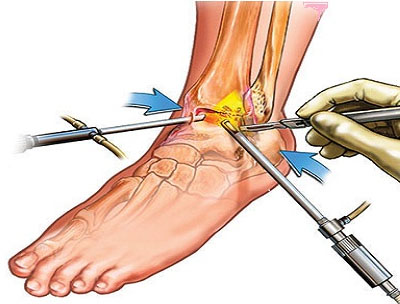
Arthroscopy is a minimally invasive surgical procedure used to examine and treat problems inside a joint. It involves inserting a small, camera-equipped instrument called an arthroscope through a small incision to visualize the joint's interior. This allows surgeons to diagnose and repair joint damage using specialized instruments inserted through additional small incisions.
Here's a more detailed explanation:
Minimally Invasive: Arthroscopy is considered minimally invasive because it requires only small incisions, typically less than a centimeter in length, compared to traditional open surgery.
Diagnostic and Therapeutic: Arthroscopy can be used for both diagnosis (identifying the cause of joint pain or dysfunction) and treatment (repairing damaged tissue).
Joints: It's commonly performed on the knee, shoulder, hip, wrist, and ankle.
How it works:
The arthroscope, a thin tube with a camera and light source, is inserted through an incision to provide a magnified view of the joint on a monitor. Surgical instruments are then inserted through other small incisions to perform repairs.
Recovery:
Because of the smaller incisions, patients typically experience less pain, swelling, and a faster recovery compared to traditional open surgery.
Common conditions arthroscopy treats include:- Cartilage tears (like labral or meniscus tears)
- Joint impingement (like ankle, shoulder or hip impingement)
- Joint instability (like ankle or knee instability)
- Ligament tears (ankle sprains, wrist sprains and knee ligament tears)
- Nerve compression syndromes (like carpal tunnel syndrome)
- Synovitis (often an early stage of rheumatoid arthritis)
- Faster return to activities
- Less postoperative pain
- Minimal blood loss and scarring
- Less risk of complications
Anesthesia:
Arthroscopy can be performed under general anesthesia, regional anesthesia, or even local anesthesia, depending on the specific case.
The benefit of arthroscopy over open joint surgery is that it’s minimally invasive. This means:
Even minimally invasive surgery carries a small risk of surgical complications, like:
- Blood clots
- Excessive bleeding
- Damage to nearby tissues
- Infection
- Nerve injury (usually temporary)
- Stiffness after surgery
Surgical complications are rare. If they do occur, your healthcare team will know what to do.